How to Buy Land in Asaba
The 2026 Insider’s Guide to Buying Land in Asaba Without the Stress
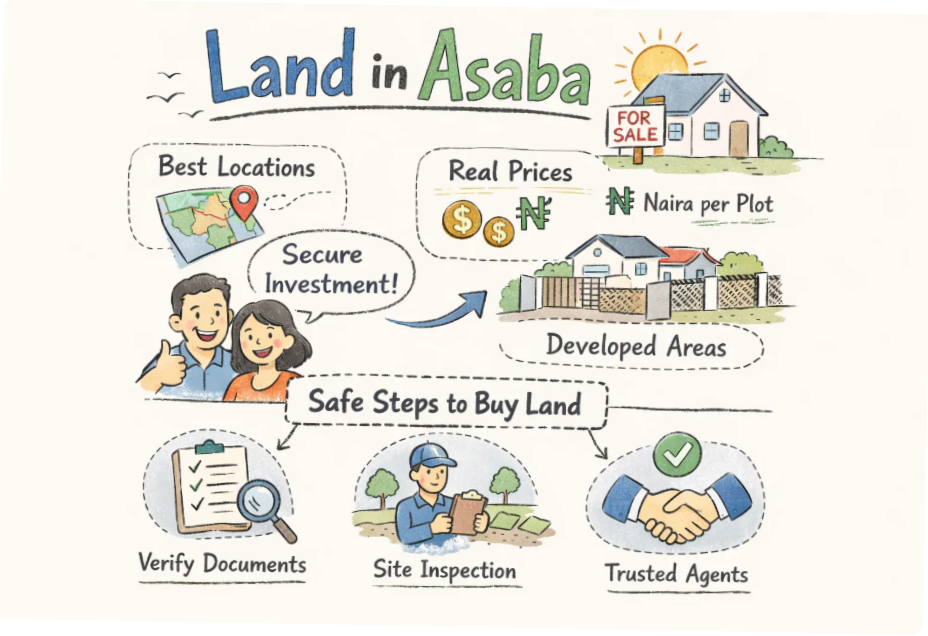
You found the plot. The price looks right. The agent sounds convincing. And somewhere in the back of your mind, a voice is saying: "Don't overthink it. Asaba land is moving. If I wait, I'll miss it."
That voice has cost people millions.
I've watched it happen — buyers who moved fast, paid in cash, skipped the title checks, and spent the next three years in land disputes they never saw coming. One family I know lost over ₦8 million on a plot in a fast-growing Asaba corridor because they trusted a referral without running a single verification step. The land had been sold to two other buyers the same week.
This is not a warning to scare you away from buying land in Asaba. It's the opposite.
Asaba is one of the smartest land investment decisions a Nigerian can make in 2026 — if you know exactly what you're doing. The infrastructure investment is documented. The demand is real. The window is open. But the same conditions that are driving prices up are also attracting fraudsters, fake agents, and title complications that can turn a great opportunity into a legal nightmare.
This guide gives everything you need to buy land in Asaba correctly: the best neighborhoods to target, realistic price ranges for 2026, the fraud patterns to watch for, and the complete legal process to complete a safe purchase. No filler, no generic advice borrowed from a playbook built for a different market. This is Asaba — and this is how the market actually works.
Why 2026 Is One of the Best Windows to Acquire Land in Asaba
The infrastructure moves are reshaping land value
Land value in any city depends on one thing above all else:
infrastructure. And right now, Asaba has more infrastructure movement than it has seen in a generation.
The Benin-Asaba Expressway dual carriageway — a 125km federal PPP project — flagged off in March 2025 and recorded significant progress by early 2026, including binder course completion across key sections. When a road like this reaches completion, what happens to the plots along its corridor? They reprice upward, fast.
The Oko link roads, built 1 meter above the 2012 flood level for resilience, are targeting full completion by June or July 2026. The six-lane access road to the Asaba Waterfront City was on track as of early 2026, extending toward the River Niger corridor.
Better road access does one specific thing: it reduces travel time, opens up previously bypassed zones, and draws investor attention to plots that looked peripheral six months ago. The plots sitting in those corridors today will not be at today's prices once construction concludes.
The Asaba Waterfront City and What It Signals
The 352-hectare Asaba Waterfront City — a joint project between North China Construction Company and Foklands Nigeria Limited — is targeting completion of land reclamation by 2028. The twin "Niger City" development is already pulling investor interest toward nearby land corridors.
Delta State's approved infrastructure budget for 2026 exceeds ₦400 billion, covering roads, utilities, and urban upgrades across Asaba and surrounding areas. When a state government approves infrastructure spending at this scale, adjacent land values have historically surged. And it's already happening.
The buyers who act while infrastructure is still under construction capture the appreciation that comes when the roads open and the land develops. That window is now.
Best Neighborhoods to Buy Land in Asaba: Where to Look and Why
Established Zones — Lower Risk, Proven Demand
Oshimili South
Oshimili South is the administrative core of Asaba, Delta State's capital, housing the Local and State Government Secretariats and the city's thriving residential, commercial, and cultural activities. Its proximity to the GRA makes it a reliable draw for professionals and investors who want city-center access. Listings here move faster than peripheral zones, and they command premium prices that reflect genuine demand.
Umuagu
offers urban accessibility and established infrastructure at somewhat lower price points than GRA-adjacent plots. For buyers relocating to Asaba or seeking residential land with existing infrastructure, this is one of the more practical options in the city.
Ibusa Growth Corridor
Ibusa and the areas along the Asaba-Benin Expressway are evolving into a prime commercial-residential blend. Areas like Okpanam Road see infrastructure surging—smart investors target 3-5 year appreciation along this high-potential corridor.
Price Benchmarks
In
GRA-bordering areas, selected asking prices exceed ₦2M per square meter (premium 450 sqm plots often ₦3.5-6M+), well above city averages. Treat as directional guides, not fixed rates—lower verification risk, higher entry costs.
Emerging Corridors — Better Entry Prices, Higher Due Diligence Required
Okpanam
This is one of the most consistently mentioned emerging zones among Asaba agents and serious buyers. Residential demand is expanding, prices remain below central Asaba, and the proximity to the city means buyers can benefit from spillover growth without paying city-center premiums.
Akwukwu-Igbo
This is more peripheral but improving infrastructurally. Plots near the Asaba International Airport access roads are attracting investors, positioning ahead of commercial development in that corridor.
One thing to note about emerging zones: lower prices aren't a reason to skip verification steps. In fact, they are a reason to tighten them. Customary and government-acquired land overlaps are more common in peripheral corridors, and this is where rushed buyers most frequently encounter title problems.
What Land Actually Costs in Asaba Right Now: 2026 Price Ranges
Price by Area and Plot Size
Standard plots of roughly 450–500 square meters average between
₦3.5 million and ₦6 million across emerging parts of Asaba. Pre-launch promotional pricing from developers occasionally pushes as low as
₦1 million
to
₦2.5 million
— but these require careful vetting of the developer and title before any commitment.
For 300 sqm plots in mid-range areas, asking prices typically range from ₦2 million to ₦4.5 million, based on current listings. Please treat this as an estimate rather than a fixed rate, given how quickly conditions shift.
Fancy land near shops or busy spots costs ₦30 million
or more. Some super nice 560sqm plots even sell for
₦46 million to ₦80 million.
Active listings on platforms like
Nigeria Property Center
aggregate Asaba land-for-sale listings, ranging from roughly 179 to 486 plots at any given time, with average asking prices hovering around ₦8 million per plot. These numbers fluctuate — check the platform directly for current accuracy.
What Actually Drives Price Differences Between Two Plots in the Same Area?
This is the question most buyers don't ask, and it costs them.
Road access:
A plot sitting 200 meters from a paved road will cost noticeably less than one with direct access, even within the same estate. That gap is real — and it stays real when you eventually want to sell or develop.
Title type:
A Certificate of Occupancy commands a real premium over bare land or customary titles because the buyer's legal exposure is lower. That premium is not negotiation leverage — it's a reflection of genuine value.
Development status of the surrounding estate:
Serviced estates with paved internal roads and perimeter fencing price higher upfront, but they eliminate hidden development costs that open layouts pass to you later. Budget for total acquisition cost, not just the sticker price.
Existing infrastructure:
Water and electricity are already on site, which adds to the listing price but reduces your post-purchase costs. Do the math before deciding that a cheaper plot without services is the better deal.
The Land Scams You Need to Know Before You Pay a Single Naira
How Buyers Lose Money in Asaba's Land Market
Fake agents
operate by presenting themselves as legitimate representatives, walking buyers through a plot inspection, collecting a deposit or full payment, and disappearing. They have no ownership rights and no connection to the actual title holder. This is more common than many buyers realize, especially in high-demand corridors where urgency can be created.
Omonile (Ndi Ogbe) fraud is specific to indigenous landholding families: one family member sells land that either the family has already partially transferred or that requires collective family consent, and then other members return,
demanding additional payments under threat of reclaiming the land. The buyer ends up in a dispute they never anticipated with people they never signed a contract with.
Multiple sales
involve the same plot being sold to different buyers simultaneously, using forged survey plans and fake documents. You pay. Three weeks later, you discover you're one of four "owners" of the same land.
The Red Flag You Must Never Ignore
The Asaba-specific version of "too good to be true" pricing is a documented pattern. When a plot in a high-demand area is priced significantly below the neighborhood average, and there is pressure to decide quickly, that is a signal to slow down, not speed up. Urgency is almost always manufactured. Legitimate sellers don't need to rush you past the verification stage.
How to Verify a Plot Is Clean Before You Commit: The Full Checklist
Run every one of these steps before any money changes hands. Not most of them. All of them.
1. Survey Plan Cross-Check:
Obtain the survey plan and cross-check the coordinates at the Delta State Ministry of Lands and Survey to confirm the plot is not encumbered or double-registered.
2. Certificate of Occupancy Verification:
Confirm the C of O is valid and not revoked at the Land Registry. Do not accept a photocopy as proof of anything.
3. Governor's Consent Confirmation:
Verify that Governor's Consent was properly granted and registered — not just claimed by the seller or agent.
4. Court Search:
Search the High Court or Magistrate's Court to check for active litigation involving the property.
5. Family Ownership Confirmation (for customary land):
Meet the family head and key members with a lawyer present to confirm the collective ownership agreement. One person's signature is not enough.
Critical rule:
Never pay in full before these steps are complete. Hire a licensed lawyer and a registered surveyor for this process — not someone referred by the agent selling you the plot. Cash payments create no paper trail and will complicate any future dispute or registration process. The cost of professional verification is a fraction of what you lose in a disputed transaction.
Step-by-Step: How to Complete a Legal Land Purchase in Delta State
From Site Inspection to Deed Execution
Step 1 — Physical Inspection:
Visit the land in person. Check drainage patterns, flood exposure, and boundary markers against the survey plan. Do not rely on photos or a virtual tour.
Step 2 — Official Ownership Verification:
Your lawyer confirms the title chain at the Ministry of Lands, verifying it is intact and that no government acquisition claims exist on the plot.
Step 3 — Negotiate in Writing:
Document the agreed-upon price, payment terms, and possession date before any money changes hands. Verbal agreements are not enforceable.
Step 4 — Deed of Assignment:
The Deed must contain the full legal details of both parties, a precise land description referencing the survey plan, the purchase price, the execution date, and signatures of both parties with witnesses.
Step 5 — Traceable Payment: All payments should go through a bank with a clear description referencing the transaction. This creates a traceable record in case a dispute arises later.
Governor's Consent and Land Registry Registration
After executing the deed, apply for the Governor's Consent at the Delta State Ministry of Lands. Attach the executed Deed of Assignment and Survey Plan. Fee payment is structured as a minimum of 40% upfront, with the balance paid in two installments of 30% each.
Once consent is granted, submit to the Land Registry for stamp duty (the federal baseline rate for land transfers is 1.5% of the property value) and registration fees to receive your Certificate of Occupancy.
Why can't registration wait
Without registered ownership, your title cannot be legally enforced against third parties — including a future seller who attempts to transact the same plot. Skipping or delaying registration is one of the most common and costly mistakes buyers make, and it is entirely preventable.
Application forms are available from the FastTrack Delta ICT Center, Ministry of Lands and Surveys, inside the Professor Chike Edozien Secretariat, Maryam Babangida Way, Asaba — between 9 am and 3 pm, Monday to Friday. Completed applications can also be submitted by email to
fasttrack@deltastate.gov.ng
What Separates a Trustworthy Land Agent from a Risky One
Before you engage any agent for an Asaba land transaction, ask these questions directly:
- Are they registered, and can they prove it?
- Can they provide verifiable references from completed transactions in Asaba specifically — not just anywhere in Nigeria?
- Do they refer you to an independent lawyer for title checks, or do they pressure you to skip that step?
- Do they disclose all fees upfront without adding costs mid-transaction?
National listing platforms like
Nigeria Property Center and
Private Property
aggregate inventory but do not verify the agents behind those listings. A presence on those platforms is not a trust signal on its own.
Why Local Asaba Expertise Is Not Optional in This Market
Meridian Vista Properties
fills a gap that generic platforms and out-of-town agencies cannot.
We work through land transactions across Delta State daily. We know which corridors in Asaba are moving right now, which title types are common in specific neighborhoods, and which verification steps matter most for the area you're targeting. Our network includes licensed surveyors and lawyers with direct experience in Delta State Land Registry processes — which means your due diligence is handled by people who already know the terrain, not learning it at your expense.
Our approach covers the full transaction: property search, estate listings and plot sourcing, title verification, surveyor and lawyer referrals, and post-transaction support, including contractor connections for buyers who plan to develop.
The place where buyers most often lose time or money in this market is not from obvious scams. It's from preventable delays and title complications that experienced local agents catch early — and out-of-town agents miss entirely.
The Five Decisions That Determine Whether Your Asaba Land Purchase Goes Smoothly
1. Choose the right neighborhood for your specific goal — whether that's proximity to the city center, corridor appreciation, or lower entry costs in an emerging zone. Each requires a different strategy.
2. Know what realistic pricing looks like
for the area and plot size you're targeting, so you can identify outliers in both directions. A plot priced 40% below the corridor average is not a deal. It's a question.
3. Run full title verification before any money moves
— using a licensed lawyer and surveyor. No shortcuts. No exceptions.
4. Complete registration immediately
after the deed is executed. Don't let an unregistered title sit while you figure out the next step. It's the single most important protection you have.
5. Work with an agent who knows the Delta State market specifically
— not one applying a framework built for Lagos, Port Harcourt, or Abuja to an Asaba transaction.
Ready to Buy Land in Asaba? Here's Your Next Step.
The infrastructure investment is documented. The demand is real. The window for 2026 pricing is still open — but it is not indefinitely open. Plots in Asaba's best corridors are already moving.
Before you pay a deposit on any plot, before you sign anything, before you trust any agent's word — reach out to the
Meridian Vista Properties team.
We offer verified Asaba estate listings, a free consultation on your target area or specific plot, and agent referrals across Asaba and the broader Delta State market. If you are a serious buyer, a diaspora investor positioning from abroad, or a professional looking to own land in one of Nigeria's fastest-growing state capitals, this is where your conversation starts.
📍 4 Obienwe Street, off Benin-Onitsha Expressway, Asaba, Delta State
🌐meridianvistaproperties.com 📧
info@meridianvistaproperties.com
Verified land. Real prices. Local expertise. That is how Meridian Vista Properties works — and it is the only way we work.
Frequently Asked Questions
Can I start investing in real estate in Nigeria without a lot of money?
Yes — and this is perhaps the most important thing to understand about real estate in Nigeria. You do not need to be wealthy to begin. My father was a petty trader with modest savings when he bought his first plot of land. What matters is not the size of your starting capital but the decision to start. Many people are waiting to feel financially comfortable before they invest, but that comfort rarely arrives on its own. A small plot of land in an emerging area — bought early and held patiently — will always outperform a large savings balance sitting idle in a bank account. The entry point for real estate in Nigeria is far lower than most people assume. Start where you are, with what you have.
How does land appreciate in value in Nigeria?
Land in Nigeria appreciates through a combination of infrastructure development, population growth, commercial migration, and government attention. When a government begins building roads, markets, or public facilities in an area, businesses and residents follow. As more people move into an area, demand for land increases — and with demand comes higher prices. This is exactly what happened in the story above. A piece of land that appeared worthless in the early 1990s became a prime commercial address once the surrounding city began expanding toward it. The key insight is that land does not create its own value — the activity around it does. Buying ahead of development, in areas where growth indicators are already visible, is the core strategy behind every successful real estate investor in Nigeria.
Is real estate a good investment in Nigeria in 2026?
Real estate remains one of the most reliable wealth-building vehicles available to Nigerians, particularly in fast-growing cities like Asaba, Enugu, and Abuja. While inflation, currency fluctuation, and economic uncertainty create anxiety in financial markets, land and property consistently hold or increase their naira value over time. In fact, periods of economic uncertainty are historically when the smartest property purchases are made — because hesitation from the majority creates opportunity for the few who act. Cities like Asaba in Delta State are currently experiencing significant infrastructure investment, commercial growth, and population influx, making them particularly attractive for both short and long-term real estate investment in 2026 and beyond.
What are the risks of buying land in Nigeria and how do I avoid them?
The most common risks when buying land in Nigeria include purchasing land with disputed ownership, buying without a verified title document, dealing with unregistered land agents, and purchasing in areas with no clear development trajectory. Here is how to protect yourself: Always verify the land title — the most secure documents in Nigeria are a Certificate of Occupancy (C of O) or a Governor's Consent. Never buy from an individual without involving a registered estate agent or property lawyer. Conduct a land search at the relevant state's Land Registry before any payment. Insist on a proper deed of assignment or contract of sale. Work with reputable, verifiable real estate companies — such as Meridian Vista Properties — who conduct due diligence on every listing they present to clients.
How long should I hold land before selling it in Nigeria?
There is no universal rule, but the general principle is this — the longer you hold land in a growth corridor, the greater your return. In Nigeria's emerging cities, significant appreciation typically begins to show within 5 to 10 years of purchase, and compounds substantially between 10 and 20 years. The story in this post is a perfect illustration: a plot purchased in the early 1990s had appreciated dramatically by the early 2000s — roughly a decade later. That said, the right time to sell is determined by your personal financial need and the maturity of the market around your land, not by an arbitrary timeline. The worst reason to sell land is impatience. The best reason is that the land has served its purpose in your wealth-building strategy and a better opportunity is available.
Why is Asaba a good place to invest in real estate?
Asaba, the capital of Delta State, has emerged as one of the most attractive real estate markets in southern Nigeria for several compelling reasons. First, infrastructure: the city has seen consistent government investment in roads, utilities, and public facilities, making it increasingly livable and commercially viable. Second, geography: Asaba sits at a strategic crossroads — close to Anambra State, connected to the Niger Bridge which is the gateway into the south east, and accessible from both the south-south and south-east geopolitical zones, giving it a natural commercial advantage. Third, affordability: compared to Lagos and Abuja, Asaba still offers entry-level land and property prices that represent significant upside potential. Fourth, growth trajectory: Asaba is a city on the rise — population influx, new businesses, and expanding residential demand all point to continued appreciation. For investors seeking high returns in an underpriced, high-growth market, Asaba is one of Nigeria's most compelling opportunities right now.
What is the difference between building wealth and earning salary?
A salary is income — it flows in when you work and stops when you do not. Wealth is ownership — it grows while you sleep, continues when you are ill, and outlasts you entirely. The fundamental difference is that a salary trades your time for money, while ownership makes your money work independently of your time. In practical terms: a salary pays your rent, your school fees, your food, and your lifestyle — but it rarely creates surplus fast enough to change your financial position. A property asset, on the other hand, does three things simultaneously: it holds value against inflation, it can generate rental income, and it appreciates over time — creating wealth that compounds without requiring your daily effort. The lesson from this story is not that salaries are bad. It is that salaries alone are not enough. Ownership is what converts a working life into a lasting legacy.