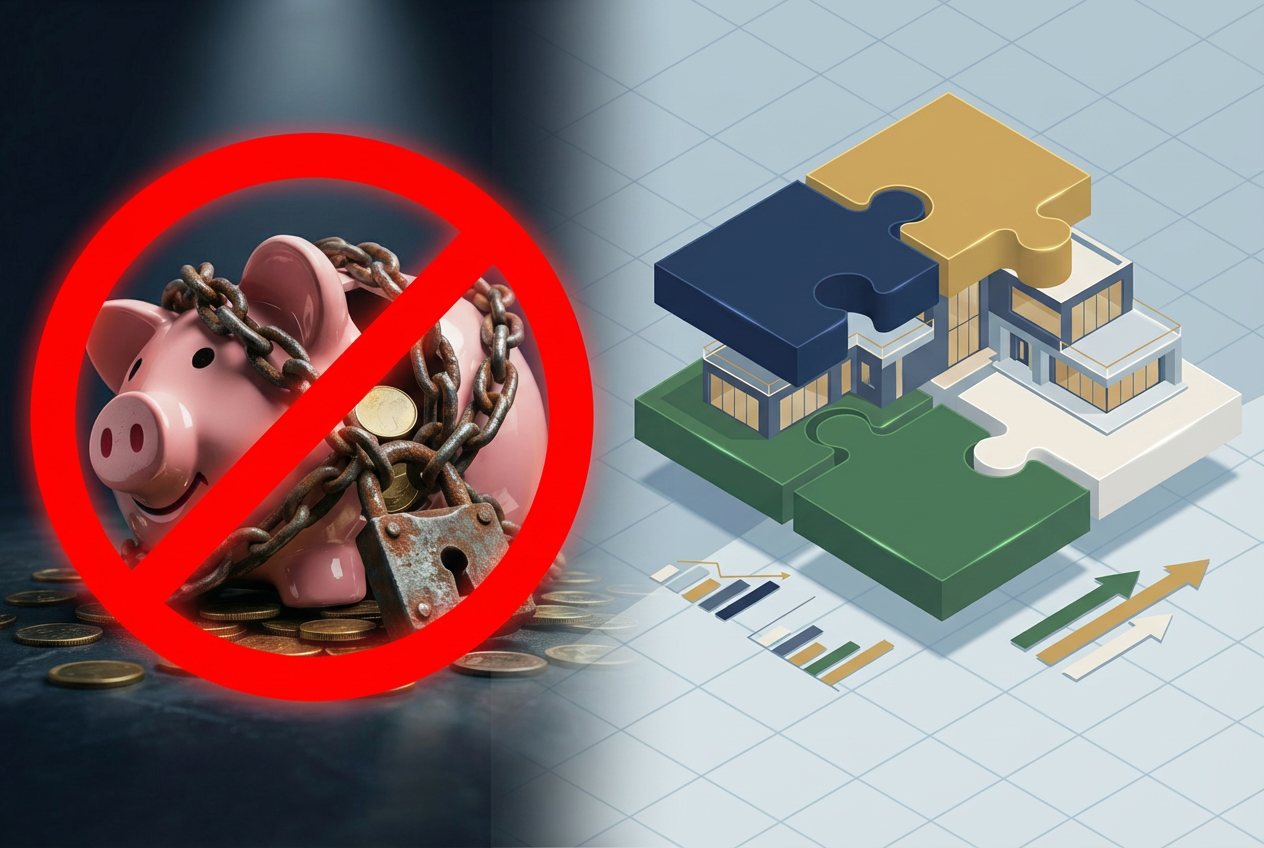
What Nobody Tells You Before You Buy Land in Nigeria
The Real Risk Is Not What You Think
(5 minutes Read)
Every day in Nigeria, a hardworking person loses their life savings to a real estate deal that looked perfectly fine on the surface. Not because they were careless. Not because they were unintelligent. Because nobody ever told them what to look for.
Here’s something strange about Nigerian real estate.
It is one of the quickest ways to grow your money — we've said it before and we'll say it again, because the data proves it. But it can also wipe out your wealth just as fast.
That’s not a contradiction.
That’s a perception problem.
Most people believe the danger in property investment is market risk — prices falling, demand drying up, infrastructure delays.
But in Nigeria, the bigger risk is something else entirely.
The difference between the person who builds wealth through property and the person who loses everything is not luck. It is not connection. It is not even money.
It is knowledge.
Specifically — knowing what the dangers are BEFORE you walk into them.
This post is the conversation most people avoid. The one that tells the difference between investors who actually build wealth and those who end up with nothing but regret.
We are going to be direct with you today. We are going to name the exact mistakes that are costing Nigerians millions every year in real estate. We are going to show you the warning signs. And at the end of every single one, we are going to tell you exactly how we make sure none of these things ever happens to you.
Read this slowly. Share it with someone you care about. It might be the most important 5 minutes they spend this year.
So here they are. The five real estate mistakes that are quietly killing Nigerian investors right now. No sugar coating. No big grammar. Just the truth.
1. Confusing Paperwork With Ownership
In Nigeria, paperwork can exist without protection.
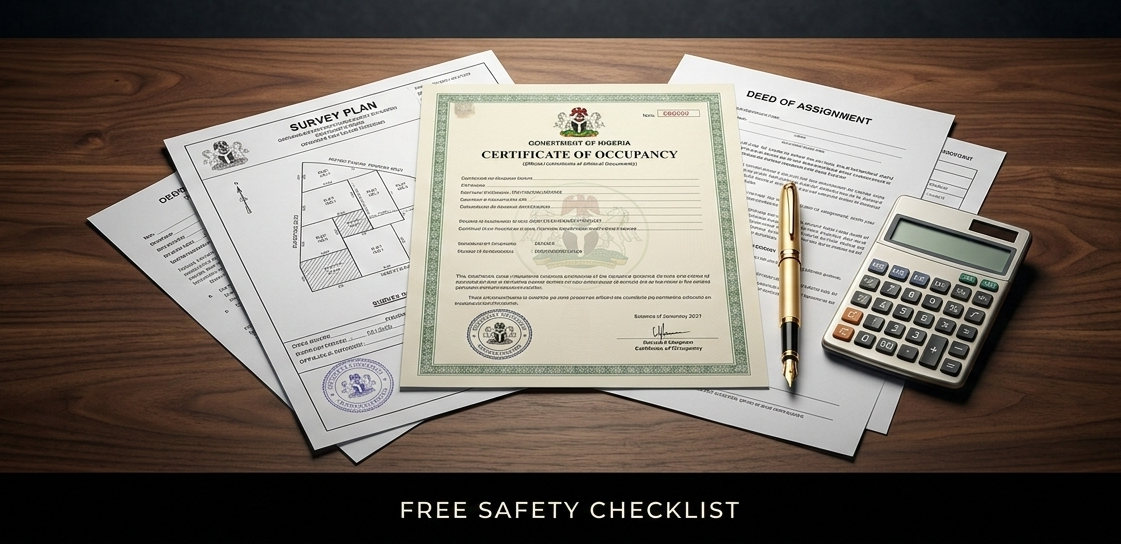
A survey plan is not a Certificate of Occupancy.
A deed of assignment is not government recognition.
A receipt is not legal control.
Ownership is not what someone gives you.
It is what the government recognizes.
Let's say you see a plot of land. The price is good. The location is excellent. The seller seems trustworthy. You pay. You are handed a piece of paper. You feel like a landowner.
Then one day — weeks, months, sometimes years later — someone else shows up with a Certificate of Occupancy for that same piece of land. And legally, they own it. Not you.
This happens in Nigeria more than you want to know.
The Certificate of Occupancy — commonly called a C of O — is the document issued by the state government that gives you the legal right to occupy and use a piece of land. Without it, you do not actually own the land in the eyes of Nigerian law. You own a piece of paper that means very little when someone with proper documentation shows up.
The sellers who do not have a C of O will give you other documents instead. A survey plan. A deed of assignment from a previous owner. A family receipt. These documents have value — but they are not a substitute for a C of O and they do not give you the same legal protection.
Always ask for the C of O. If they cannot produce it, find out why. If the answer is not completely satisfactory, walk away.
✅ HOW MERIDIAN VISTA PROTECTS YOU:
Every single property Meridian Vista Properties Ltd presents to clients comes with full documentation verification. We check the C of O status, the survey plan, the deed history, and any encumbrances on the land before we ever show it to you. You will never be handed a property with questionable documentation and no explanation. That is a promise.
2. Buying What You Saw on a Screen
Beautiful drone shots.
Professional brochures.
WhatsApp testimonials.
None of these are land.
Real estate is physical.
Serious investors treat it that way.
This one exploded during the pandemic and has never stopped.
Someone sends you a beautiful video of a property. The brochure is professionally designed. The WhatsApp group has hundreds of members all testifying. The agent is smooth. The price is perfect.
You pay. You wait. The videos stop. The agent disappears.
There is no land.
There never was.
Or worse — there is land, but it is swampy. It is government-acquired. It is in a disputed area. It floods every rainy season. And you only discover this after your money has left your account.
The rule is simple: Never pay for Nigerian real estate without physically visiting the land or sending a trusted representative to verify it in person. Beautiful photos are not land. A professional website is not land. Only land is land.
For diaspora Nigerians who cannot travel, this means engaging a reputable on-the-ground partner who will physically inspect, document, and verify the property on your behalf before any money moves.
✅ HOW MERIDIAN VISTA PROTECTS YOU:
For every property we list, Meridian Vista conducts physical site inspections and provides verified documentation. For our diaspora clients, we offer a dedicated inspection service — we visit the site, document everything with photos and video, and give you a complete verification report before you commit a single Naira. You see what is real before you pay for it.
3. Ignoring Local Intelligence
Local knowledge compounds faster than capital.
Knowing which corridor in Asaba will benefit from infrastructure expansion is worth more than negotiating small discounts.
Smart investors team up with people who have actually been there and done it before.
In Nigeria, there are two types of real estate traps that are easy to miss if you don't know what to look for.
The first is land that floods. It looks perfectly fine and dry during the early months of the year. But when the heavy rains arrive in July and August, that same land turns into a river. People have actually built homes on such land, moved in, and then watched helplessly as floodwater destroyed everything they owned. This happens every single year in many Nigerian cities — including some parts of Asaba, close to the Niger River.
The second is Land taken over by the government. This is land that the state or federal government has already designated for a project — a road, a housing scheme, a government building, an expansion.
The land can be sold to you by a private individual. The papers can look perfectly fine. But when the government is ready to execute their project, they will come with bulldozers and you may be compensated at government rates — which is almost always far below what you paid.
Both of these situations require expert local knowledge to detect.
You cannot ask ChatGPT or Google your way out of this one. You need someone who knows the specific area, the drainage patterns, the government master plans, and the land use zoning classifications.
✅ HOW MERIDIAN VISTA PROTECTS YOU:
This is where Meridian Vista's deep, on-the-ground knowledge of Asaba's property market becomes your biggest protection. We know Asaba. We know which areas flood. We know which corridors are earmarked for government projects. We know which neighborhoods are appreciating and which ones carry hidden risk. This local intelligence — built over years of operating in this market — is something you simply cannot get from an outsider. It is yours when you work with us.
4. Trusting Branding Over Structure
A good logo is easy.
An Instagram page is easy.
Testimonials are easy.
Structure is difficult:
Corporate registration.
Physical presence.
Verifiable documentation.
Transparent process.
Investors who focus on structure over branding tend to sleep better.
Here is a question almost nobody asks before handing over money for Nigerian real estate:
Is this company actually registered?
Not just a name. Not just a logo. Not just a beautiful Instagram page with millions of followers. Is this company registered with the Corporate Affairs Commission? Do they have verifiable physical offices? Can you walk in, sit down, and speak to a real human being who will still be there tomorrow?
The Nigerian real estate space is full of operators who exist entirely on social media.
They appear professional. They sound credible. They have testimonials. And then when something goes wrong — when you need to enforce a contract, when you need to resolve a dispute, when you need to retrieve your money — there is nobody to hold accountable. No registered company. No physical address. No legal recourse.
This is not unique to small operators. There are large-looking real estate brands in Nigeria that are not properly registered and have no accountability structure whatsoever.
Before you invest in any Nigerian real estate company — crowdfunding or otherwise — verify their CAC registration number. Look them up on the Corporate Affairs Commission portal. Visit their physical office. Ask for references. Make them prove they are real.
✅ HOW MERIDIAN VISTA PROTECTS YOU:
Meridian Vista Properties Ltd is a fully registered company with the Corporate Affairs Commission of Nigeria. We have a physical office in Asaba, Delta State. We have a verified website. We have real consultants with real names and real phone numbers. We welcome every prospective client to visit us in person before committing to anything. Accountability is not a feature we offer — it is the foundation we are built on.
5. Believing Returns Without Understanding Assets
If you cannot physically inspect the asset…
If documentation cannot be independently verified…
If the exit strategy is unclear…
You are not investing in real estate.
You are investing in confidence.
And misplaced confidence is expensive.
Our previous blog post introduced you to the power of real estate crowdfunding. And we stand by everything we said. When done correctly, crowdfunding is one of the most powerful wealth-building tools available to Nigerians today.
But we would be doing you a disservice if we did not also tell you this:
Every Ponzi scheme that has ever targeted Nigerians dressed itself up as an investment opportunity. Some of them used real estate as the cover story.
The difference between legitimate real estate crowdfunding and a Ponzi scheme is not always obvious from the outside. Both promise returns. Both have professional-looking materials. Both have enthusiastic investors sharing testimonials.
Here is how you tell them apart:
Legitimate crowdfunding has a tangible, verifiable underlying asset.
You can physically visit the land or property. The title documents are real and can be independently verified. The company managing the pool is registered and accountable. There is a clear, documented exit strategy that explains exactly when and how you get your money back.
A Ponzi scheme has none of these things — or has fake versions of them. The land does not exist or cannot be visited. The documents are fabricated. The company is unregistered. The exit strategy is vague. And the returns are paid from new investors' money, not from actual property income.
Before you join any Nigerian real estate crowdfunding pool, demand to see the title documents. Demand a site visit. Demand the company's CAC registration. Demand a written exit strategy. If any of these requests is refused or deflected — that is your answer.
✅ HOW MERIDIAN VISTA PROTECTS YOU:
Every crowdfunding opportunity presented by Meridian Vista Properties Ltd is backed by a real, verified, physically inspectable property within or outside Asaba, Delta State. We provide title documentation, site access, and a clear written investment agreement that spells out your returns, your ownership stake, and your exit terms. We do not ask you to trust us blindly. We give you every reason to trust us with your eyes open.
The Bonus Mistake Nobody Talks About: Waiting for Perfect Conditions
We said five mistakes. But here is a bonus one — because it is the one that does the most quiet damage and we could not leave it out.
The mistake of waiting.
Waiting for the economy to stabilize. Waiting for the exchange rate to improve. Waiting for the political situation to settle. Waiting for more money. Waiting to be more certain.
The people who got rich from Lagos real estate in the 2000s were not waiting for perfect conditions. The conditions were actually terrible. But they bought anyway. And they won.
The people who bought in Abuja and in parts of Asaba like the 'Back of NTA' axis, and Okpanam Road axis in the early 2010s were not waiting for certainty. They jumped in before they had the complete story. And it paid off.
The good news is that pockets of Asaba still sit at exactly that kind of crossroads today. Infrastructure is expanding. Migration patterns are shifting. Opportunity rarely announces itself loudly.
We have just walked you through the five mistakes that cost Nigerian investors millions every year.
Use that knowledge. Protect yourself. And when you are ready to invest — invest with people who have nothing to hide.
Meridian Vista Properties Ltd has been built on one principle: that every Nigerian investor — whether you have ₦10,000 or ₦10 million — deserves full transparency, proper documentation, and a partner they can trust completely.
If you have questions about any property in Asaba. If you want to verify a deal before you commit. If you simply want to understand what your options are — our consultants are here. No pressure. No hard sell. Just honest conversation from people who know this market.
Contact Us
Frequently Asked Questions
Can I start investing in real estate in Nigeria without a lot of money?
Yes — and this is perhaps the most important thing to understand about real estate in Nigeria. You do not need to be wealthy to begin. My father was a petty trader with modest savings when he bought his first plot of land. What matters is not the size of your starting capital but the decision to start. Many people are waiting to feel financially comfortable before they invest, but that comfort rarely arrives on its own. A small plot of land in an emerging area — bought early and held patiently — will always outperform a large savings balance sitting idle in a bank account. The entry point for real estate in Nigeria is far lower than most people assume. Start where you are, with what you have.
How does land appreciate in value in Nigeria?
Land in Nigeria appreciates through a combination of infrastructure development, population growth, commercial migration, and government attention. When a government begins building roads, markets, or public facilities in an area, businesses and residents follow. As more people move into an area, demand for land increases — and with demand comes higher prices. This is exactly what happened in the story above. A piece of land that appeared worthless in the early 1990s became a prime commercial address once the surrounding city began expanding toward it. The key insight is that land does not create its own value — the activity around it does. Buying ahead of development, in areas where growth indicators are already visible, is the core strategy behind every successful real estate investor in Nigeria.
Is real estate a good investment in Nigeria in 2026?
Real estate remains one of the most reliable wealth-building vehicles available to Nigerians, particularly in fast-growing cities like Asaba, Enugu, and Abuja. While inflation, currency fluctuation, and economic uncertainty create anxiety in financial markets, land and property consistently hold or increase their naira value over time. In fact, periods of economic uncertainty are historically when the smartest property purchases are made — because hesitation from the majority creates opportunity for the few who act. Cities like Asaba in Delta State are currently experiencing significant infrastructure investment, commercial growth, and population influx, making them particularly attractive for both short and long-term real estate investment in 2026 and beyond.
What are the risks of buying land in Nigeria and how do I avoid them?
The most common risks when buying land in Nigeria include purchasing land with disputed ownership, buying without a verified title document, dealing with unregistered land agents, and purchasing in areas with no clear development trajectory. Here is how to protect yourself: Always verify the land title — the most secure documents in Nigeria are a Certificate of Occupancy (C of O) or a Governor's Consent. Never buy from an individual without involving a registered estate agent or property lawyer. Conduct a land search at the relevant state's Land Registry before any payment. Insist on a proper deed of assignment or contract of sale. Work with reputable, verifiable real estate companies — such as Meridian Vista Properties — who conduct due diligence on every listing they present to clients.
How long should I hold land before selling it in Nigeria?
There is no universal rule, but the general principle is this — the longer you hold land in a growth corridor, the greater your return. In Nigeria's emerging cities, significant appreciation typically begins to show within 5 to 10 years of purchase, and compounds substantially between 10 and 20 years. The story in this post is a perfect illustration: a plot purchased in the early 1990s had appreciated dramatically by the early 2000s — roughly a decade later. That said, the right time to sell is determined by your personal financial need and the maturity of the market around your land, not by an arbitrary timeline. The worst reason to sell land is impatience. The best reason is that the land has served its purpose in your wealth-building strategy and a better opportunity is available.
Why is Asaba a good place to invest in real estate?
Asaba, the capital of Delta State, has emerged as one of the most attractive real estate markets in southern Nigeria for several compelling reasons. First, infrastructure: the city has seen consistent government investment in roads, utilities, and public facilities, making it increasingly livable and commercially viable. Second, geography: Asaba sits at a strategic crossroads — close to Anambra State, connected to the Niger Bridge which is the gateway into the south east, and accessible from both the south-south and south-east geopolitical zones, giving it a natural commercial advantage. Third, affordability: compared to Lagos and Abuja, Asaba still offers entry-level land and property prices that represent significant upside potential. Fourth, growth trajectory: Asaba is a city on the rise — population influx, new businesses, and expanding residential demand all point to continued appreciation. For investors seeking high returns in an underpriced, high-growth market, Asaba is one of Nigeria's most compelling opportunities right now.
What is the difference between building wealth and earning salary?
A salary is income — it flows in when you work and stops when you do not. Wealth is ownership — it grows while you sleep, continues when you are ill, and outlasts you entirely. The fundamental difference is that a salary trades your time for money, while ownership makes your money work independently of your time. In practical terms: a salary pays your rent, your school fees, your food, and your lifestyle — but it rarely creates surplus fast enough to change your financial position. A property asset, on the other hand, does three things simultaneously: it holds value against inflation, it can generate rental income, and it appreciates over time — creating wealth that compounds without requiring your daily effort. The lesson from this story is not that salaries are bad. It is that salaries alone are not enough. Ownership is what converts a working life into a lasting legacy.