Asaba vs Warri: The Ultimate Battle for Your Property Investment Money
Which City in Delta State Will Make You Rich?
Picture this: Two cities in Delta State, Nigeria are battling for your attention—and your money.
In the blue corner, we have Asaba, the smart capital city with big plans. In the red corner, there's Warri, the tough oil city with deep pockets.
If you're in Lagos, Abuja or anywhere in the World right now, thinking about where to buy your next house or piece of land in Delta State, you're probably wondering:Which city will make me more money?
Here's the thing—this isn't just guesswork or someone's random opinion. We're about to use real numbers and actual facts to crown a winner. Think of it like choosing between a race car (super fast but needs a smooth road) and a powerful truck (can handle rough terrain and carry heavy loads). Both are awesome, but which one fits YOUR journey?
Whether you’re a serious investor or just curious about property prices in Delta State, this report has what you need.
No confusing jargon. No boring theories. Just facts about:
- Which city gives you better rent money each month?
- Which city's property values are growing faster?
- Which city is the smarter choice for your wallet?
Ready to see which Delta State superhero wins? Let’s dive in!
What Makes These Cities Grow Like Magic Beans?
Before we choose a winner, let’s see what makes each city unique. Just like superheroes, Asaba and Warri have their own special powers for growth.
Asaba's Super Powers:
The Government Hub
Think of Asaba as the king's castle for Delta State. As the capital, it's full of government offices, workers, and businesses that support them. This means there’s always a demand for rental homes.
But here’s the exciting part, Asaba is right next to the Niger Bridge. Imagine a superhighway leading straight to huge markets like Onitsha. It’s like a magic door to millions of customers.
The growth numbers are impressive: The population has more than tripled since 2006, growing by over 250%. This rapid expansion has led some experts to label it as possibly the fastest-growing capital city in sub-Saharan Africa.
The state government keeps investing, too. They’re building the more International Markets, new roads, hotels, and schools. Each new project brings more jobs, shops, and people needing homes.
Warri's Tough Tricks:
The Oil Powerhouse
Now meet Warri, the industrial powerhouse. This city has been Nigeria's oil and gas leader for decades. Major energy companies operate here, bringing money and workers who need good housing.
Warri has something Asaba lacks: major ports. Ships from around the world dock at Warri, Burutu, Sapele, and Koko, creating business opportunities everywhere.
Here’s what’s happening now: The government built the DSC Otokutu Expressway, and they’re improving bridges and power systems. Agriculture, mining, and factories in the area grew by 13% between 2016 and 2020. New flyovers and hotels are springing up everywhere.
Warri's strategy is clear—while Nigeria needs oil and gas (and will for a long time), this city will remain vital and profitable.
Both Cities Are Thriving Like Plants Getting Water
The bottom line is this: Both cities have unique growth drivers. Asaba thrives on government activity and its strategic location. Warri benefits from industrial wealth and port business.
So, which superhero deserves your investment? Let’s dive into the numbers to find out.
The Figures Game: Where Your Cash Grows Significantly
Okay, here's where things get real. We're going to look at actual money—how much you can earn from renting out properties and how much your investment grows over time.
Think of it like this:
Rental Yield =
The money you collect every year from rent (like getting allowance for letting someone use your bicycle)
Capital Appreciation =
How much more valuable your property becomes over time
We did our homework and looked at real numbers from 2025. We picked the fanciest neighborhoods where professionals and business people want to live—the kind of tenants that serious investors hunt for.
Round 1: The Rent Money Battle (3-Bedroom Apartments)
Let’s compare nice 3-bedroom apartments in the top areas of each city. We're looking at GRA in Asaba (home to government VIPs) and Effurun in Warri (the business hub).
THE ULTIMATE COMPARISON TABLE
| What We're Measuring | Asaba (GRA/Okpanam) | Warri (Effurun/Army Estate) | Winner |
|---|---|---|---|
| Average Property Price | ₦55 million | ₦45 million | Warri (cheaper entry) |
| Annual Rent You Collect | ₦1.5-2 million | ₦1.2-1.5 million | Asaba (higher rent) |
| Rental Yield (%) | 2.7-3.6% | 2.6-3.3% | Asaba (slightly better) |
| Who Rents Your Property | Government workers, professionals | Oil company staff, contractors | Tie (both stable) |
| Rental Demand Stability | Very stable (government never stops) | Stable but can dip (depends on oil prices) | Asaba |
What does this mean in simple terms?
If you buy a ₦55 million property in Asaba, you'll collect about ₦1.5-2 million in rent every year. That's like spending ₦55,000 on something and getting back ₦2,700 yearly—not bad!
In Warri, you spend less (₦45 million) but also earn slightly less rent (₦1.2-1.5 million yearly). The percentages are almost the same, but Asaba has a tiny edge.
The real difference? Asaba's rent is more stable because there are always government workers, young people, and graduates looking for homes, plus new businesses opening up. But in Warri, rent prices can go up and down depending on oil prices and how much companies are spending.
Rental Winner:
ASABA
(by a nose) ✓
Round 2: The Big Money Fight (Land Price Growth)
This is where things get WILD. Forget yearly rent—let's talk about how much richer you get when your land value explodes.
We tracked land prices in the hottest investment areas from 2022 to 2025. These are places where smart investors buy empty land, wait, and watch their money multiply.
LAND APPRECIATION SHOWDOWN
| Investment Zone | 2022 Price (One Plot) | 2025 Reserve Price (Same Plot) | Your Profit | Growth % | Annual Growth Rate |
|---|---|---|---|---|---|
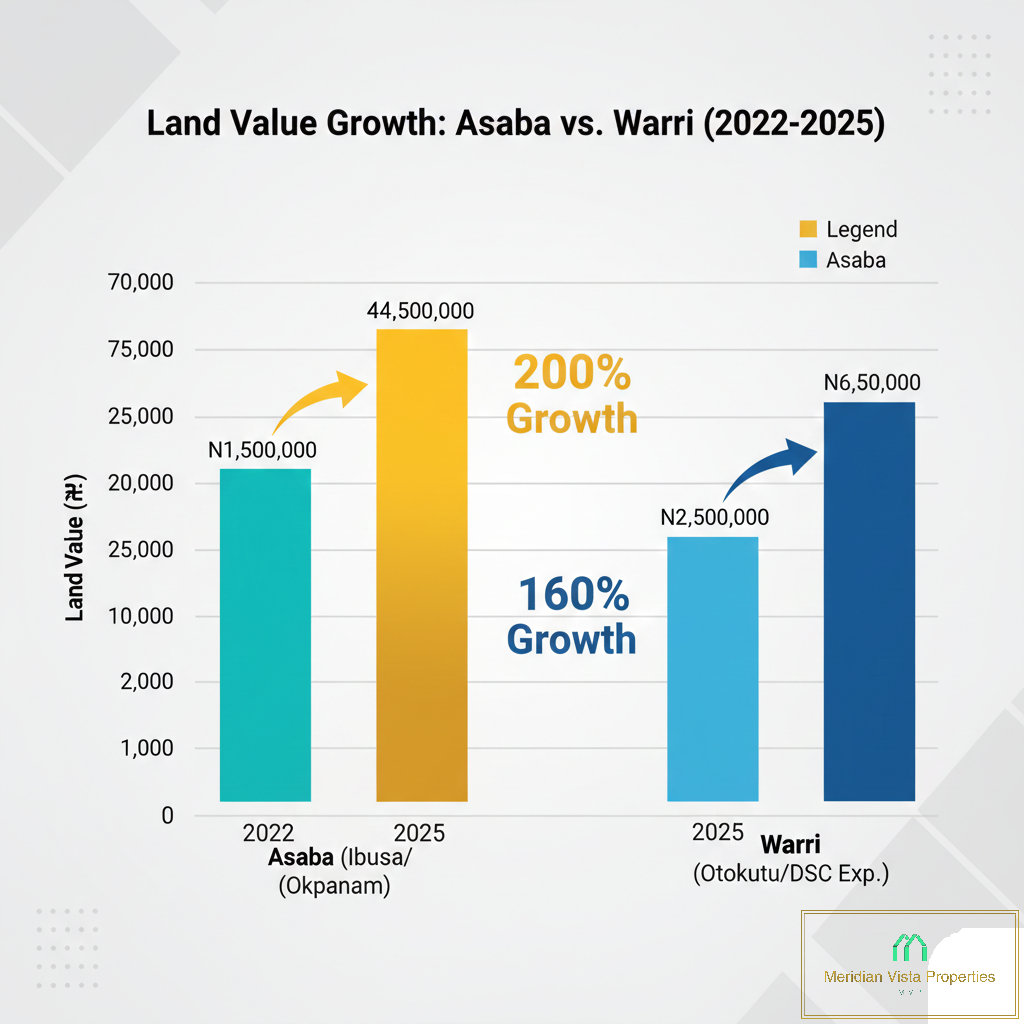
| Asaba (Ibusa/Okpanam corridor) | ₦1.5 million | ₦4.5 million | +₦3 million | 200% | 60-70% per year |
| Warri (Otokutu/DSC Expressway) | ₦2.5 million | ₦6.5 million | +₦4 million | 160% | 40-50% per year |
Wait, what just happened here?
If you bought land in Asaba for ₦1.5 million in 2022, it's now worth ₦4.5 million in 2025. You TRIPLED your money in just three years! That’s like buying a bicycle for ₦1,500 and selling it for ₦4,500 without even using it.
In Warri, you spent ₦2.5 million, and your land is now worth ₦6.5 million. You made a ₦4 million profit. It sounds big, but Asaba’s growth is faster in percentage terms.
Why is Asaba booming so quickly?
- The effect of being the main entry point from the East
- Government is expanding into new areas
- Traders from Onitsha are moving to Asaba
- People are rushing to buy before prices go up even more
Why is Warri growing steadily but slower?
- It’s a mature city (less room for rapid growth)
- Oil money is good, but it’s unpredictable
- Growing well, just not explosively
Capital Appreciation Winner: ASABA (knockout!) ✓✓
Risk Analysis: A Balanced Perspective
Every investment carries risk. It's important to grasp the unique challenges each city offers.
• Asaba: The main risk in Asaba is heavy reliance on government spending. If public sector activity drops, rental demand may fall and appreciation could slow. Investors should also watch for speculative bubbles in developing areas where infrastructure lags behind land prices.
• Warri: Warri's risks relate to its industrial base. Security issues in the Niger Delta and possible community land disputes are major concerns. The market is sensitive to global oil price changes, which can affect corporate budgets and housing allowances.
The Verdict & Your Next Step
For investors seeking high capital appreciation, Asaba stands out. Its mix of government growth, strategic location, and rapid urban expansion creates a strong growth story. While rental yields are slightly higher, the real opportunity lies in significant land value increases.
Warri is a good choice for conservative investors focused on stable, industrial-backed rental income. However, for those aiming for strong risk-adjusted returns, Asaba's growth potential is hard to overlook.
Ready to build your high-performance Delta State portfolio? This data is just the start. Contact us for a Custom Delta State Investment Portfolio Analysis to find specific, off-market opportunities that fit your financial goals.
Frequently Asked Questions
Can I start investing in real estate in Nigeria without a lot of money?
Yes — and this is perhaps the most important thing to understand about real estate in Nigeria. You do not need to be wealthy to begin. My father was a petty trader with modest savings when he bought his first plot of land. What matters is not the size of your starting capital but the decision to start. Many people are waiting to feel financially comfortable before they invest, but that comfort rarely arrives on its own. A small plot of land in an emerging area — bought early and held patiently — will always outperform a large savings balance sitting idle in a bank account. The entry point for real estate in Nigeria is far lower than most people assume. Start where you are, with what you have.
How does land appreciate in value in Nigeria?
Land in Nigeria appreciates through a combination of infrastructure development, population growth, commercial migration, and government attention. When a government begins building roads, markets, or public facilities in an area, businesses and residents follow. As more people move into an area, demand for land increases — and with demand comes higher prices. This is exactly what happened in the story above. A piece of land that appeared worthless in the early 1990s became a prime commercial address once the surrounding city began expanding toward it. The key insight is that land does not create its own value — the activity around it does. Buying ahead of development, in areas where growth indicators are already visible, is the core strategy behind every successful real estate investor in Nigeria.
Is real estate a good investment in Nigeria in 2026?
Real estate remains one of the most reliable wealth-building vehicles available to Nigerians, particularly in fast-growing cities like Asaba, Enugu, and Abuja. While inflation, currency fluctuation, and economic uncertainty create anxiety in financial markets, land and property consistently hold or increase their naira value over time. In fact, periods of economic uncertainty are historically when the smartest property purchases are made — because hesitation from the majority creates opportunity for the few who act. Cities like Asaba in Delta State are currently experiencing significant infrastructure investment, commercial growth, and population influx, making them particularly attractive for both short and long-term real estate investment in 2026 and beyond.
What are the risks of buying land in Nigeria and how do I avoid them?
The most common risks when buying land in Nigeria include purchasing land with disputed ownership, buying without a verified title document, dealing with unregistered land agents, and purchasing in areas with no clear development trajectory. Here is how to protect yourself: Always verify the land title — the most secure documents in Nigeria are a Certificate of Occupancy (C of O) or a Governor's Consent. Never buy from an individual without involving a registered estate agent or property lawyer. Conduct a land search at the relevant state's Land Registry before any payment. Insist on a proper deed of assignment or contract of sale. Work with reputable, verifiable real estate companies — such as Meridian Vista Properties — who conduct due diligence on every listing they present to clients.
How long should I hold land before selling it in Nigeria?
There is no universal rule, but the general principle is this — the longer you hold land in a growth corridor, the greater your return. In Nigeria's emerging cities, significant appreciation typically begins to show within 5 to 10 years of purchase, and compounds substantially between 10 and 20 years. The story in this post is a perfect illustration: a plot purchased in the early 1990s had appreciated dramatically by the early 2000s — roughly a decade later. That said, the right time to sell is determined by your personal financial need and the maturity of the market around your land, not by an arbitrary timeline. The worst reason to sell land is impatience. The best reason is that the land has served its purpose in your wealth-building strategy and a better opportunity is available.
Why is Asaba a good place to invest in real estate?
Asaba, the capital of Delta State, has emerged as one of the most attractive real estate markets in southern Nigeria for several compelling reasons. First, infrastructure: the city has seen consistent government investment in roads, utilities, and public facilities, making it increasingly livable and commercially viable. Second, geography: Asaba sits at a strategic crossroads — close to Anambra State, connected to the Niger Bridge which is the gateway into the south east, and accessible from both the south-south and south-east geopolitical zones, giving it a natural commercial advantage. Third, affordability: compared to Lagos and Abuja, Asaba still offers entry-level land and property prices that represent significant upside potential. Fourth, growth trajectory: Asaba is a city on the rise — population influx, new businesses, and expanding residential demand all point to continued appreciation. For investors seeking high returns in an underpriced, high-growth market, Asaba is one of Nigeria's most compelling opportunities right now.
What is the difference between building wealth and earning salary?
A salary is income — it flows in when you work and stops when you do not. Wealth is ownership — it grows while you sleep, continues when you are ill, and outlasts you entirely. The fundamental difference is that a salary trades your time for money, while ownership makes your money work independently of your time. In practical terms: a salary pays your rent, your school fees, your food, and your lifestyle — but it rarely creates surplus fast enough to change your financial position. A property asset, on the other hand, does three things simultaneously: it holds value against inflation, it can generate rental income, and it appreciates over time — creating wealth that compounds without requiring your daily effort. The lesson from this story is not that salaries are bad. It is that salaries alone are not enough. Ownership is what converts a working life into a lasting legacy.